
ITIL Service Management cuts IT costs by 40% while improving service quality – according to the IDC Study. Companies struggle with service disruptions, inefficient processes, and poor IT-business alignment. ITIL Service Management Framework solves these problems through proven practices.
Most IT teams face three critical issues:
- Service outages that hurt business operations
- Wasted resources on ineffective processes
- Disconnected IT that doesn’t support business goals
ITIL Service Management Practices provide structured solutions. Teams get clear guidelines for service delivery. Results include faster incident resolution and higher customer satisfaction.
ITIL Service Management Framework Evolution in 2025
ITIL 4 replaced rigid processes with flexible practices. The new Service Value System focuses on continuous value creation rather than linear workflows.
ITIL 4 vs Previous Versions Impact on Modern Organizations
ITIL v3 used a five-stage lifecycle: strategy, design, transition, operation, improvement. Teams moved sequentially through stages. This created delays and bottlenecks.
ITIL 4 Service Management introduces flexible workflows:
- Continuous improvement across all activities
- Cross-team collaboration without barriers
- Customer-focused decisions at every level
- Adaptive processes that change with needs
The new model has 34 management practices instead of 26 processes:
- General Management – Standard business activities
- Service Management – IT-specific practices
- Technical Management – Technology operations
Organizations report 50% faster service delivery with ITIL 4.
AI-Driven Service Management Integration
AI transforms ITIL Service Management Tools through automation and prediction. Machine learning prevents issues before they affect users.
Key AI capabilities:
- Automated incident detection using real-time monitoring
- Predictive analytics for capacity planning
- Chatbots handling routine requests
- Pattern recognition identifying recurring problems
AI reduces manual work in ITIL Service Management Processes:
- Routes incidents automatically to correct teams
- Suggests solutions from previous cases
- Updates records in real-time
- Generates reports without human input
Teams using AI see 50% faster response times and higher satisfaction scores.
Top ITIL Service Management Practices in 2025

Core ITIL Service Management Principles for Maximum Value
Seven ITIL Service Management Principles guide all service decisions. These principles create value-focused teams that deliver consistent results.
Focus on Value Creation in Service Delivery
Value means benefits customers receive from services. Teams must understand real customer needs, not assumptions.
Every activity should benefit someone:
- End users need reliable, helpful services
- Business leaders need services supporting company goals
- IT teams need efficient, stress-free processes
- Customers need consistent service experiences
Service Level Management measures value through user-focused metrics:
- Response times for service requests
- Availability rates for critical applications
- User satisfaction from regular surveys
- Business impact from service improvements
Ask two questions before any change:
- Who benefits from this change?
- How will we measure the benefit?
Start Where You Are Assessment Strategy
Build on existing capabilities instead of replacing everything. ITIL Service Management Framework recommends practical improvements over complete overhauls.
Assessment steps:
- Document current state – Map existing services
- Identify strengths – Find what works well
- Spot gaps – Locate improvement areas
- Plan changes – Design realistic improvements
Use existing tools and skills when possible. New technology only makes sense when current solutions fail to meet requirements.
Assessment requires honest evaluation without blame. The goal is improvement through realistic planning.
Progress Iteratively with Feedback Loops
Small changes reduce risk. ITIL Service Management Practices emphasize incremental improvements over major transformations.
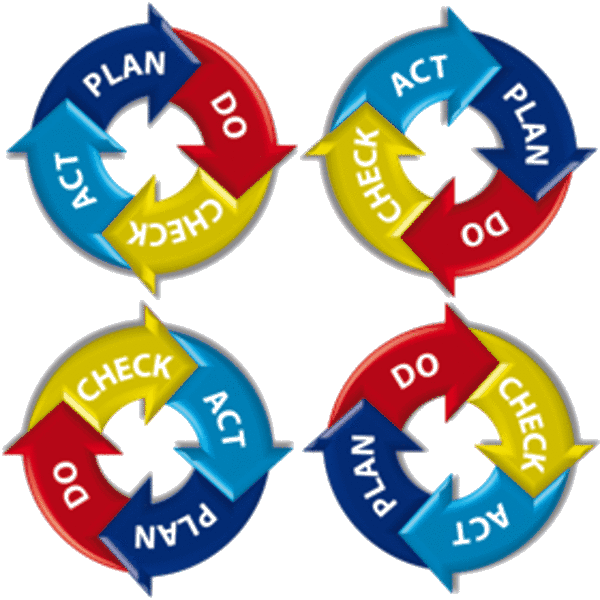
The PDCA cycle prevents costly mistakes:
- Plan small improvements
- Do implement changes quickly
- Check results against expectations
- Act on lessons learned
Feedback loops ensure learning from every change:
- Daily standups for immediate issues
- Weekly reviews for process improvements
- Monthly assessments for strategic alignment
- Quarterly planning for major initiatives
Real-time data provides objective feedback about performance. Teams see immediately whether changes help or hurt service quality.
Essential ITIL Service Management Processes That Drive Results
Five ITIL Service Management Processes deliver consistent service quality. Teams mastering these processes reduce costs by 30% while improving satisfaction.
Service Strategy Implementation
Service Strategy decides which services to offer and why. Teams analyze business needs and competitor services to guide investment decisions.
Key activities:
- Market analysis – Study customer needs and competitors
- Portfolio management – Choose services to build or retire
- Financial management – Calculate costs and set prices
- Demand forecasting – Predict future requirements
Customer demand data reveals usage patterns. Teams track seasonal variations and growth trends for capacity planning.
Strategy teams meet monthly with business leaders. Marketing initiatives and expansion plans significantly affect service demand.
Service Design Best Practices
Service Design converts strategy into working services. Teams define requirements, processes, and success metrics. Good design prevents operational problems.
Design areas:
- Service solutions – Features and architecture
- Management systems – Operational tools
- Technology platform – Infrastructure needs
- Operating procedures – Daily workflows
- Performance metrics – Measurement methods
Service Level Management sets realistic performance targets. Teams balance customer expectations with technical limits.
Design reviews include business and technical stakeholders. Business confirms requirements. Technical teams verify feasibility and costs.
Service Transition Management
Service Transition moves services from design to production safely. Proper transition prevents service disruptions through controlled change management.
Core activities:
- Change management – Control modifications to reduce risk
- Release management – Deploy services into production
- Service testing – Verify correct operation
- Staff training – Prepare operational teams
Change management protects stability. All modifications need approval with risk assessment and rollback plans.
Testing includes functional, performance, security, and integration checks. Comprehensive testing catches problems before user access.
Service Operation Excellence
Service Operation runs services daily while maintaining quality. Teams handle incidents, process requests, and monitor performance.
Key activities:
- Incident management – Fix disruptions quickly
- Problem management – Eliminate root causes
- Request fulfillment – Process user requests
- Access management – Control permissions
Incident management prioritizes speed and communication. Teams restore services first, investigate causes later. Clear escalation handles complex issues efficiently.
The service desk provides a single user contact point. Trained staff resolve simple issues immediately. Complex problems go to specialists with proper documentation.
Continual Service Improvement Methods
Continual Service Improvement keeps services relevant and efficient through systematic enhancement.
Improvement cycle:
- Measure performance – Collect quality data
- Analyze results – Understand data meaning
- Identify improvements – Find opportunities
- Plan changes – Design projects
- Validate results – Confirm expected benefits
Key performance indicators track service health objectively:
- Availability percentages for critical applications
- Response times for different request types
- User satisfaction scores from surveys
- Cost per transaction for delivery
Trend analysis spots performance patterns over time. Teams identify degradation, seasonal changes, and process bottlenecks to guide improvement priorities.
PDCA Consulting Maximize your ITIL Service Management
PDCA Consulting helps organizations implement effective ITIL service management with expert training and proven methodologies.
- ITIL Training: Learn from certified instructors
- Custom Implementation: Tailored service workflows
- Process Optimization: Faster service delivery
- Team Development: Skilled ITSM teams
- Continuous Improvement: PDCA methodology for IT operations
- Business Results: Reduced costs, higher customer satisfaction
Conclusion
ITIL Service Management delivers measurable business value through structured service delivery practices. The framework’s evolution to ITIL 4 provides organizations with flexible, value-driven approaches that reduce costs while improving service quality and customer satisfaction.
Modern ITIL implementation succeeds through iterative improvement, AI-enhanced automation, and unwavering focus on business outcomes. Organizations that embrace these principles create resilient IT services capable of adapting to changing market demands and technological advances.
Frequently Asked Questions
Should I implement ITIL alongside ISO 20000 certification?
ISO 20000 provides an audit framework and formal governance for ITIL implementation. Certification satisfies regulatory requirements in healthcare, finance, and government sectors while demonstrating service management maturity to stakeholders.
How does ITIL integrate with cloud service providers?
Cloud environments require adapted capacity management, security controls, and vendor relationship approaches. Focus on shared responsibility models – understand which ITIL processes you control versus those managed by cloud providers.
What’s the role of Service Owners versus Process Owners?
Service Owners manage end-to-end performance and customer satisfaction for specific business services. Process Owners ensure effectiveness of individual ITIL processes across all services. This separation optimizes both service quality and process efficiency.
Can ITIL work with microservices architecture?
Microservices require business service views rather than technical component focus. Use service mesh technologies for visibility while ITIL processes provide governance for service mapping, dependency management, and incident resolution.
How do I handle ITIL in multi-vendor environments?
Establish clear service integration points, shared escalation procedures, and unified reporting standards. Regular supplier reviews ensure vendor alignment with ITIL processes and service level commitments across all providers.
What’s the difference between Major Incident Management and standard processes?
Major Incident Management activates for business-critical failures or large user impact. This triggers executive communication, dedicated war rooms, and accelerated escalation that bypasses normal incident workflows.
How does GDPR compliance affect ITIL Service Management?
Data protection regulations require ITIL processes to include data classification, consent management, and breach notification workflows. Privacy impact assessments become mandatory components of service design activities.
Should I use ITIL for internal services like HR systems?
ITIL principles apply beyond IT infrastructure to any service delivery scenario. HR systems, financial applications, and business processes benefit from structured incident management, change control, and performance monitoring.
How do I measure ITIL maturity in my organization?
Use capability maturity models examining process repeatability, management support, tool integration, and continuous improvement activities. Assess process capability, automation levels, cultural adoption, and measurable business outcomes.
What’s the impact of remote work on Service Desk operations?
Distributed teams require enhanced collaboration tools, updated escalation procedures, and modified performance metrics. Implement robust knowledge management systems and clear communication protocols for cross-timezone service quality.