Seven vendors, seven project managers, no defined programme, and the governance that would have saved it.
If you are the sponsor, the CIO or the PMO lead of an enterprise implementation with more than two suppliers on it, this one is for you.
Every supplier on your enterprise implementation reports green. Each one has its own project manager, its own steering group and its own slide deck. Nobody can tell you what the whole thing is worth, or whether it’s winning. Your go-live date has moved twice, and both times it was somebody else’s fault. And when you ask who owns the outcome, the room goes quiet and studies the ceiling tiles.
That’s an enterprise implementation with plenty of management and no governance.
I once walked onto a site where seven organisations were delivering one enterprise implementation, and every single one of them thought it was in charge. I’ve been called in to untangle a fair few of these, and this was the worst. Plenty of implementations wobble. This one didn’t wobble. It fell down the stairs and apologised to nobody.
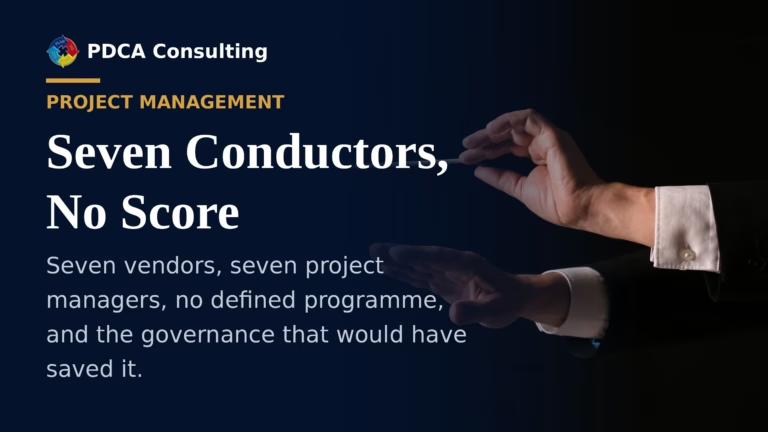
Picture an orchestra. Now sack the conductor, hand each section its own baton, and forget to print the score. The strings are sawing at Mahler, the brass are lost somewhere in Wagner, and the percussion have wandered off to charge you twenty hours for a triangle. That was the sound of this enterprise implementation, except nobody had ever defined it as a programme, so it doesn’t even deserve the word.
Eric Kimberling, an expert witness who has spent two decades picking over ERP disasters, notes that when a transformation falters the blame flies everywhere at once: customer, implementer, vendor and third-party systems, all pointing at each other. What follows is the post-mortem the client should have been handed on day one.
In this blog, we’ll explore:
- Why a governance vacuum set the whole enterprise implementation up to fail
- How the people problems turned a difficult project into a hostile one
- Where the process failures actually bit, and what they cost
- The five outcomes that would have kept the music together
The Company: A Portfolio That Forgot to Bring a Process
Nobody had defined what was a programme and what was a project. No one on site carried the title “project manager,” which meant no one carried the accountability either. You don’t have a team. You have seven strangers in a corridor, each assuming the adult in the room is somebody else.
Seven organisations were involved: the franchisee, the franchisee’s owner, the patent owner, the core supplier, the integrator, a second supplier, and a subcontracted IT function. Each brought its own project manager and steering group. With no consolidated reporting and no consolidated business case, no single soul could say what the enterprise implementation was worth.
The bitter irony: a portfolio function sat on top of all this, dutifully listing projects. Its one job is to give the business a single view of everything in flight and whether it still serves the strategy. It had decided its people were too good to need a process: very confident about which projects existed, entirely silent on where they were going.
The selection decision poured petrol on the pyre. The core-system supplier already had a cheaper integration that worked. For reasons lost to history and, I suspect, to a golf day, the client chose an integrator inherited from an upstream supplier, whose integration then had to be rebuilt on site, under a contract that never defined anyone’s accountabilities. Kimberling is blunt and correct: the biggest danger in an enterprise implementation is rarely the software, it’s how you select and integrate it.
Who, by name, owns the outcome of your biggest enterprise implementation right now?
The People: Kudos, Panic, and Nowhere Safe to Fail
If the governance vacuum built the trap, the people problems sprang it.
The pre-project site visit was done by people who weren’t involved in delivery and didn’t know what to ask. The integrator, sensing an audience that couldn’t tell a firewall from a fire door, cheerfully pulled the wool over their eyes. The same visitors reappeared later, when things were on fire, with a strong opinion and no idea how the system worked.
Meanwhile the franchisee’s owner panicked and did what panicking owners do: added people. The newcomers spread chaos and misleading information, and chased personal kudos while the real work went unloved. The integrator simply stopped attending meetings. And when an enterprise implementation this tangled slips, everyone reaches for the reflex Kimberling describes: blame the other party rather than fix the root cause.
Underneath it ran something uglier, and I won’t dress it up. This was an international enterprise implementation, and with no psychological safety and managers who valued the numbers over the people producing them, cross-national friction curdled into open hostility and, at its worst, discriminatory abuse along national lines. The org chart spanned Germans, Swedes, English, Indians and Americans, and it behaved like a Eurovision voting bloc. That isn’t a cultural quirk. It’s a leadership failure, full stop. A team that doesn’t feel safe will never own up to the firewall still being shut, and if nobody admits what’s broken, nobody learns from it either.
The Process: No Beginning, No End, and a Twenty-Hour Backup
With no roles and no safety, the process was simply absent. Nothing had a proper start, and nobody had defined when a project could close, so nothing ever did. There were no checkpoints to ask whether the work was still worth doing, and no agreed limits on time or cost, so when reality drifted (daily) there was no route to escalate it.
The integrator had no idea which ports the system used, so every firewall opening failed, got raised, failed again and repeated like a very expensive screensaver, all learned at the client’s expense.
My personal favourite: the integrator billed twenty hours for a backup and restore that takes two, then did essentially nothing for a month. When I suggested we might not pay for the month of nothing, the reaction was less “fair point” and more “fireworks over the harbour.” Nobody caught it, because there were no controls to catch it with. And lessons learned? Seven rival knowledge-management systems, each quietly breaking the others, and not a shared lesson between them.
When did a lessons-learned session last change anything on your enterprise implementation?
Warning: you might be running seven-conductor governance if…
- No one actually holds the title of project manager, yet everyone insists someone does
- “Programme” and “project” are used interchangeably and defined nowhere
- Every party runs its own steering group and reports its own shade of green
- The phrase “lessons learned” produces either blank faces or a fresh round of blame
How to Fix an Enterprise Implementation: One Score, One Baton
I don’t do “it depends” endings, so here’s my position: this enterprise implementation didn’t fail because seven organisations are too many. It failed because seven organisations were governed as if they were none. The repair isn’t heroic. It’s boring, and boring is the point.
One person owns the outcome, and everyone can name them without checking. Accountabilities are written down on day one, so “who decides?” has a one-word answer instead of a fortnight of emails.
The integrator’s real team is vetted before anyone signs. The contract spells out who answers for what, and, as Kimberling recommends, you check the people who’ll actually turn up and shore up their weak spots rather than praying.
Every project in the enterprise implementation knows when it has started and when it’s allowed to stop. A proper start, checkpoints to confirm the work still earns its keep, agreed limits that trigger an escalation the moment they’re breached, and an up-front definition of “closed” so projects actually end.
The shut firewall gets mentioned on Tuesday, not in the go-live post-mortem. People who feel safe reporting bad news report it early, and early is cheap.
The board sees one picture of the whole enterprise implementation, not seven shades of green. Projects chasing the same outcomes run as one programme: one sponsor accountable for the benefits, one board, one set of reporting instead of seven fan-fictions.
How many shades of green is your steering group being shown this month?
An orchestra with seven conductors and no score doesn’t make challenging music. It makes noise, and then it makes lawyers rich. Governance is simply the score and the person holding the baton: the least glamorous thing in the room, and every single time the thing whose absence you hear loudest.
That twenty-hour backup alone was billed at ten times what the job takes, and nobody spotted it. Multiply that by seven suppliers and a year of unchecked months, and the missing governance cost far more than the governance would have.
The PRINCE2 family of methods (certification paths at peoplecert.org/browse-certifications/project-programme-and-portfolio-management) exists to write that score, and a PMO Assessment & Improvement is the quickest way to find out which instruments in your enterprise implementation are playing from different sheets.
To find out more about PDCA Consulting’s expert consulting services either:
- Book 30-minute conversation directly: here
- Get in touch via the contact form here
- Connect with me on LinkedIn
Robert Pinnington
Turning struggling Service Desks & PMOs into high-performing ones