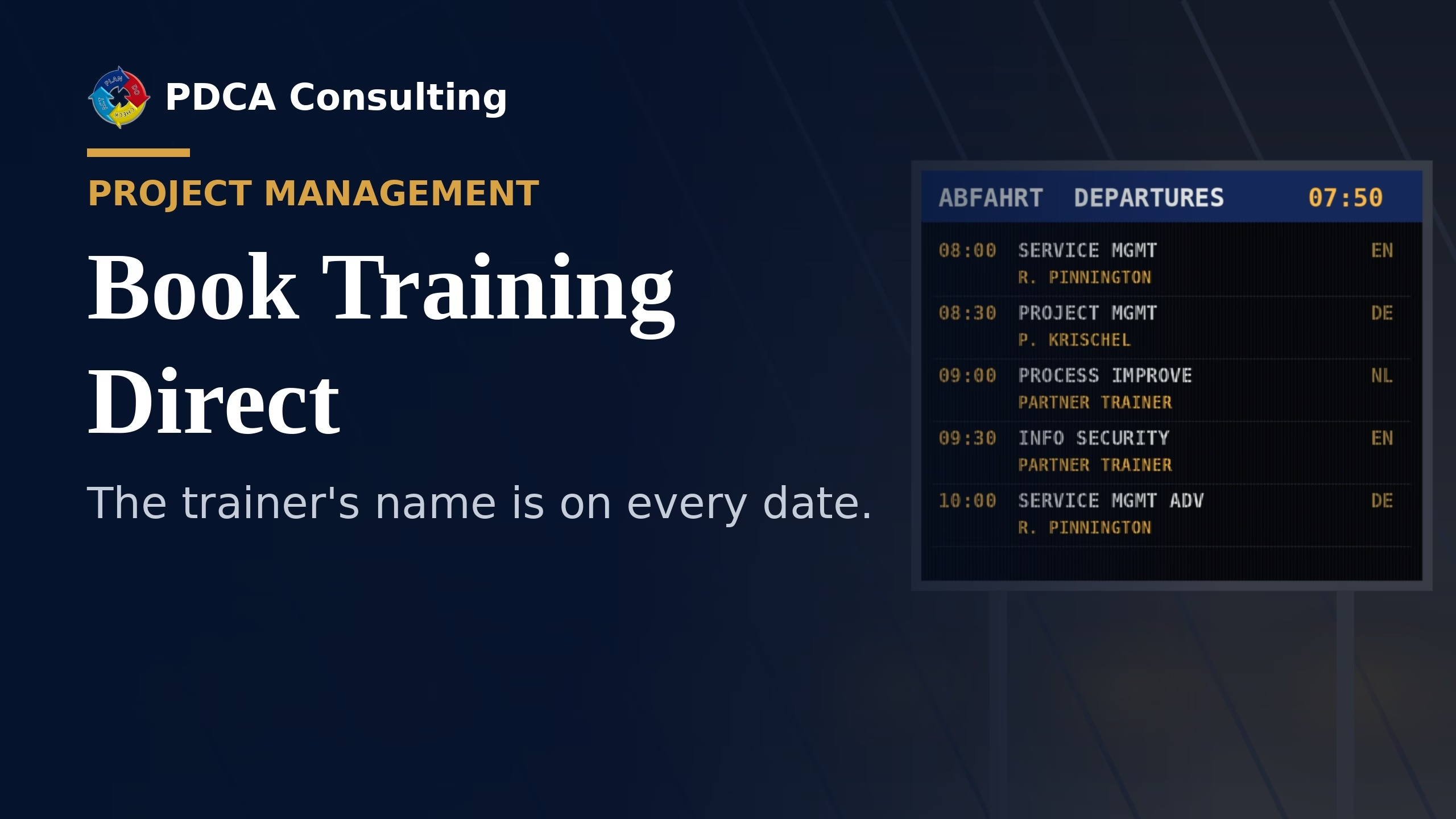
Same course, same price, different carriage
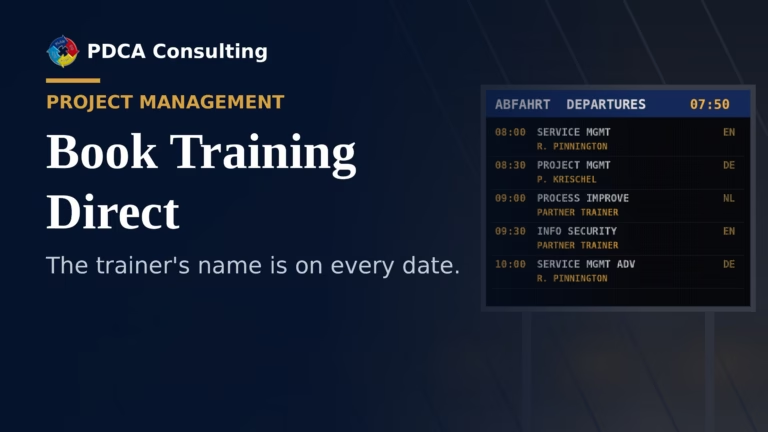
Picture the departures board at Frankfurt Hauptbahnhof at ten to eight on a Monday. You know where you’re going. You know roughly what the ticket costs. What the board doesn’t tell you is whether you’ll get a quiet carriage with a table, or a standing slot next to the toilets with a stag party from Mainz.
Most teams buy certification training exactly like that. They compare the price and the dates, pick the cheapest departure, and find out who’s driving when they sit down on day one.
You’ll recognise the pattern if it’s yours. The course was booked through someone who books courses. Nobody spoke to the trainer before the money left the account. The examples in the room came from a textbook, not from a desk or a project office that had actually been in trouble. And three weeks later, the certificate is framed and the Monday morning chaos is unchanged.
By the end of this post, you’ll know where to book training direct with the people who teach it, and who it suits best. The short answer: one course calendar, real trainers’ names on every date, and a conversation with them first if you want one.
I’ve spent years being called in after the training budget was spent and the problem was still there, so I’m biased. I’d rather people knew who was at the front of the room before they paid for the seat.
Why book training direct with the trainer
When you book training direct, the guesswork about the driver goes. You see the trainer’s name on the date before you pay. You can talk to them about your team, or about the one process that keeps going wrong. And the stories they tell in the room come from organisations that were genuinely struggling and got better, not from a case study written for the manual.
That matters more than the syllabus. Two courses with identical content can feel like two different subjects, depending on whether the person teaching has done the work or only read about it.
Who taught the last course your team sat, and could anyone name them a month later?
One board, several trains
Here’s what’s new, and why it’s now easier to book training direct. The PDCA Consulting Academy now lists every scheduled course in one place, and it isn’t only my courses.
Through my partnership with Peter Krischel and Polychor, I can now offer live virtual training direct to individuals, not only to teams who come to me for a closed course. Polychor sells the places, and the calendar carries courses taught by Peter and me alongside courses from partner trainers.
So the departures board shows several trains, and every one has the driver’s name on it:
- Service management courses, from Foundation through to the advanced modules, with me or Peter
- Project management certification courses at Foundation and Practitioner level, with Peter
- Process improvement and process modelling courses, taught by a partner trainer who specialises in them
- Information security, data protection and risk certifications from partner trainers
Courses run live online, in English, German or Dutch, depending on the date.
What you’ll see before you book training direct
Open the PDCA Academy course page and pick a date. Each one shows the full programme and the price, plus how many places are still free, and you book and pay online. No reseller in the middle, no “we’ll get back to you with availability”.
If you only want one subject, the calendar has filtered views. The service management dates sit on one page and the project management dates on another, so you don’t scroll past six months of courses you’ll never take.
If you’re still choosing between certification paths, the official certification pages set out each path and its prerequisites. My ITIL & PRINCE2 Training & Certification page explains the options in plain English.
Which course has been sitting on your team’s “next quarter” list for more than a year?
Who booking direct suits best
The choice to book training direct isn’t right for everyone. It suits four kinds of people.
- People paying their own way. When you book training direct, you see the full price and the dates up front, and you choose the trainer as well as the date.
- Team leads booking two or three people. Talk to the trainer first and check the course matches what your team actually needs to change, not just what HR has a budget line for.
- People who’d rather learn in German or Dutch. The same courses run in more than one language, so nobody has to sit an exam in their second language just because that was the only date.
- Organisations with six or more people. Book a call instead. A closed course built around your own processes usually works out better than six seats on a public one, and it doesn’t go through the course page.
After you book training direct
Booking is the start, not the finish. Once you book training direct, you get the trainer’s contact details rather than a generic support inbox, so the questions you’d normally save for the coffee break can come before day one.
On the course itself, you learn live, with coaching and practice exams built in. You then sit the official exam online. If the material is going to be used at work the week after, say so when you book. A good trainer will bend the examples towards your situation rather than the textbook’s.
That last part is where most courses fall down. The certificate proves somebody passed an exam; it doesn’t prove anything changed back at the desk.
The trainer is part of the ticket
The trainer shouldn’t be a surprise you discover at 9:00 on day one. When you book training direct, the name is on the date and the course is one you chose, rather than one that was chosen for you.
What would change in your team if everyone came back from the course using the same words on Monday morning?
You now know where to book training direct and that you can talk to the person teaching you before you pay. The trainer stops being a lottery and becomes part of the decision.
Leaving it costs more than it looks. Every month the course sits on the “next quarter” list is another month of the team improvising its own version of the process, with the same incidents and the same late projects handled the same way.
To find out more about PDCA Consulting’s expert consulting services either:
- Book 30-minute conversation directly: here
- Get in touch via the contact form here
- Connect with me on LinkedIn
Robert Pinnington
Turning struggling Service Desks & PMOs into high-performing ones