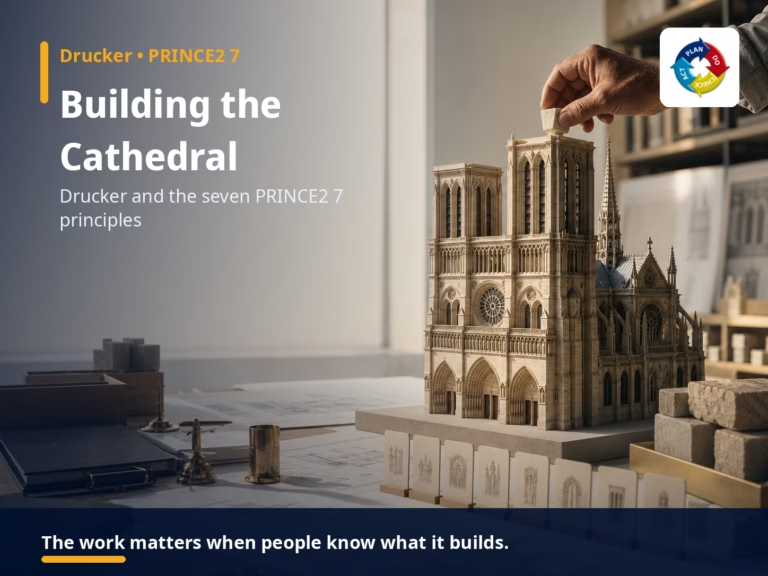
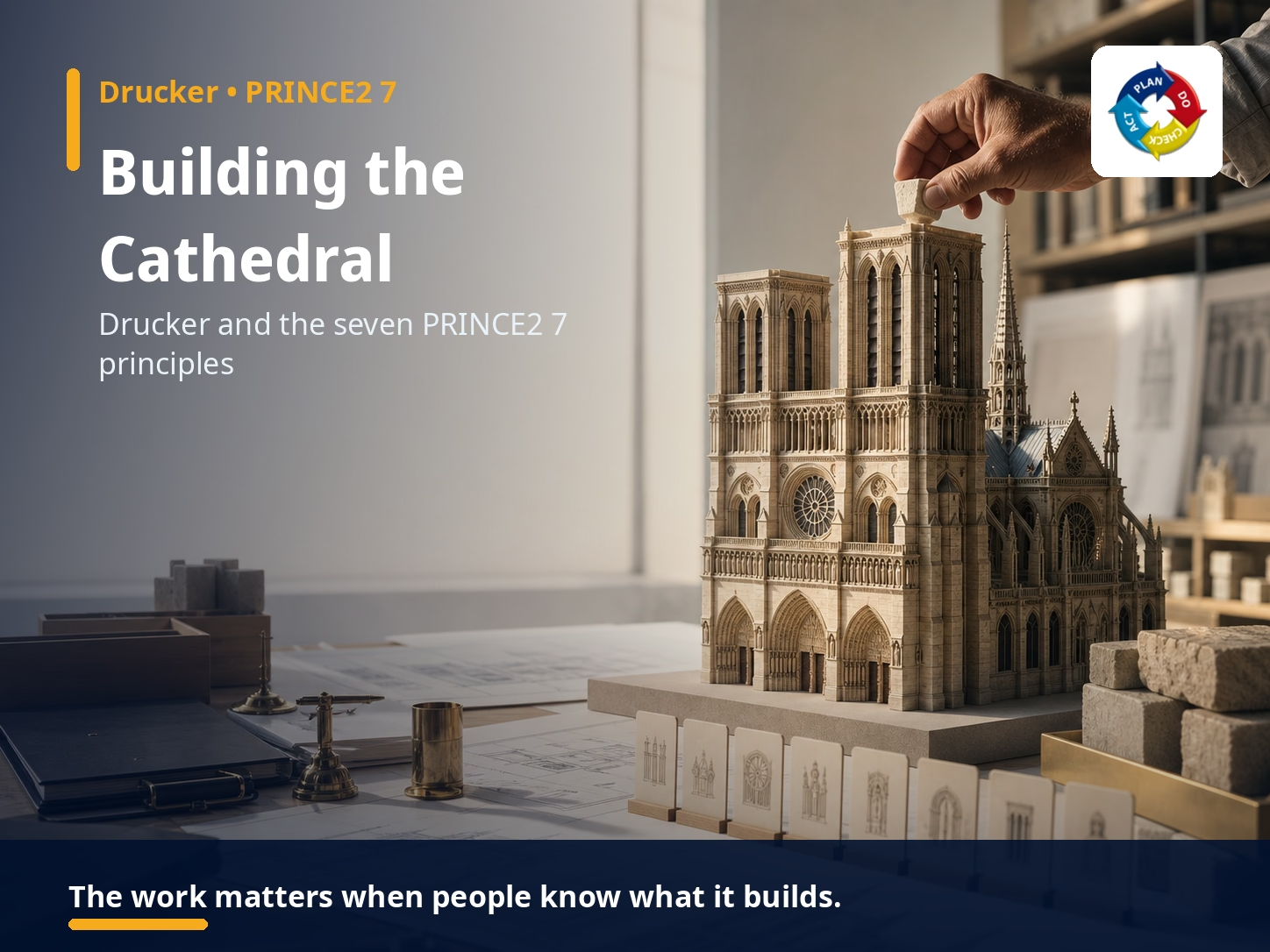
Drucker's cathedral story is a practical way to understand why PRINCE2 7 principles still work.
In The Practice of Management, the 1954 book I dragged on holiday this summer, to the bafflement of everyone near my sun lounger, Peter Drucker tells of a traveller who meets three stonecutters and asks what they are doing. The first is earning a living. The second is doing the finest stonecutting in the county. The third looks up and says, "I am building a cathedral."
The third man is the hero, and Drucker's whole book is really a method for producing more of him: managers and teams who know exactly what the work builds and why it matters. Reading it with a project manager's eye, I found each of PRINCE2 7's seven principles already argued and evidenced, seventy years early. That's the best endorsement a method can get, its foundations were proven before it was written, which is exactly why the principles reward being learned properly and applied on every project.
In this blog, we'll explore all seven PRINCE2 7 principles, each paired with the Drucker example that anticipated it.
In this article
Ensure continued business justification
Sears keeps asking the question
Drucker's Sears, Roebuck story is a masterclass in justification that never stands still. Julius Rosenwald built the mail-order business on a clear answer to "what is our business", being the informed, reliable buyer for the isolated American farmer. When the motor car turned that farmer into a town shopper, Robert E. Wood asked the question again and took Sears into retail stores. Same company, renewed justification, spectacular results.
That is ensure continued business justification in action: the reason for the endeavour is checked throughout, and when circumstances change, the answer changes with them. Sears prospered for half a century by treating its business case as a living document. Drucker gives the story a whole chapter, and it reads like the minutes of a project board that actually re-reads its own business case at every boundary.
Learn from experience
Henry Ford II and the borrowed blueprint
When Henry Ford II took over the company his grandfather had driven to the edge of collapse, he didn't improvise. He rebuilt Ford deliberately on the decentralised management model already proven elsewhere in the industry, lessons learned from a rival's experience, applied wholesale, and vindicated by one of the great corporate recoveries. Drucker presents it as evidence that management can be learned, which was the book's most optimistic claim in 1954 and remains its most useful one.
Learn from experience asks project teams to seek lessons from previous and comparable work and act on them. Ford II turned that principle into a revival worth billions.
Define roles, responsibilities, and relationships
Federal decentralization and the five jobs of a manager
Drucker's preferred structure, federal decentralization, works precisely because everyone knows their part: autonomous divisions run their own businesses, central management sets direction and standards, and the boundary between the two is explicit. He also defined the manager's own role once and for all, set objectives, organise, motivate and communicate, measure, develop people, including yourself.
PRINCE2 7's principle asks every project to achieve the same clarity, and the 7th edition strengthened it: define roles, responsibilities, and relationships, with People now one of the method's five integrated elements. Drucker would applaud the addition, relationships were always the part he thought mattered most.
Manage by stages
Objectives with a time horizon
Drucker insisted objectives carry explicit time spans, balance the short range against the long, and come up for genuine review rather than roll forward on autopilot. His managers commit to a defined period, measure the results, and re-set the objectives in light of them, commitment in deliberate instalments, not one heroic promise at the start.
Manage by stages is that discipline applied to projects: plan in detail only the stage you can see, review at each boundary, and recommit, or don't, on evidence. It's the difference between steering and hoping, and Drucker had his managers doing it decades before stage boundaries had a name.
Manage by exception
Self-control beats supervision
The chapter that made the book famous is "Management by Objectives and Self-Control", and the second half of the title carries the treasure. Give each manager clear objectives and the measurements to track their own performance, Drucker argued, and they will correct course themselves; their superior need step in only when things genuinely run off track. Self-control produces performance and frees senior attention for the decisions only seniors can take.
Manage by exception is the project-shaped version: agree tolerances, delegate authority within them, escalate only on a forecast breach. The project board doesn't attend stand-ups for the same reason Drucker's chief executive didn't approve shift rotas, both have better things to do, by design.
Focus on products
What the stones are for
Back to the stonecutters. The third man's advantage isn't enthusiasm; it's that he can describe the finished product. Drucker's point is that every contribution should be defined by what it builds, the cathedral comes first, and the stonecutting is derived from it. The second stonecutter, superb craftsman that he is, only becomes fully effective the day someone shows him the drawings.
Focus on products gives every project that drawing: define the deliverables and their quality criteria first, then derive the work from them. In PRINCE2 7 terms, the product description is the architect’s drawing, agreed and quality-checked before anyone lifts a chisel. It is the fastest route I know for turning second stonecutters into third ones, and most teams have more potential third stonecutters than they realise.
Tailor to suit the project
Structure follows analysis
Drucker rejected the universal org chart. The right structure, he argued, emerges from analysing the specific business, its activities, its decisions, its relationships, and different businesses rightly land on different designs. The method serves the work; the work never serves the method.
Tailor to suit the project is the same wisdom, stated for projects: adapt the method to the project's environment, size, complexity and risk. PRINCE2 7 makes tailoring a principle rather than a footnote, which is Drucker's argument winning the long game.
The view from the scaffolding
Seven principles, one cathedral
Every PRINCE2 7 principle stands on ground Drucker surveyed in 1954, with named companies and measurable results as the proof. That's not a criticism of the method, it's the strongest recommendation for it. Principles that have held for seventy years are principles worth building on, and PRINCE2 7 turns them into something you can teach and apply on Monday morning. The lesson for all of us is simple: learn them properly, implement them fully, and make sure everyone on the project can answer the traveller's question the way the third stonecutter did.
For the companion piece pairing Drucker with ITIL (Version 5)'s seven guiding principles, see the previous PDCA blog, same holiday, same remarkable book.
To find out more about PDCA Consulting:
- Contact us via the contact form at pdcaconsulting.com
- Book a 30-minute meeting at Robert Pinnington’s calendar
- Connect with PDCA Consulting on LinkedIn
- Call us on +49 172 5794719