Peter Drucker's 1954 management lessons map cleanly onto the seven ITIL (Version 5) guiding principles.
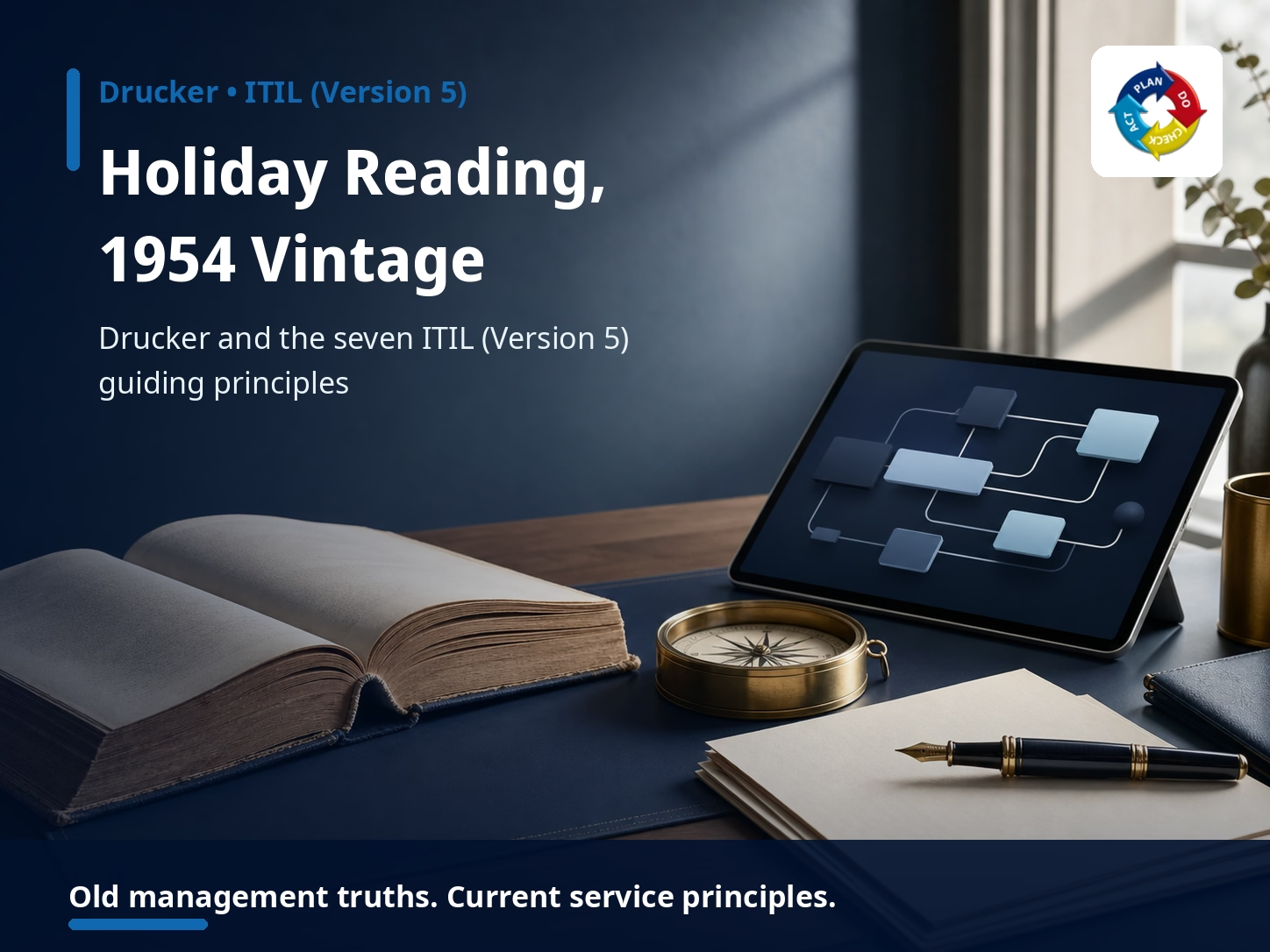
This summer I did what every self-respecting consultant does on holiday: walked past the airport thrillers and packed a management book from 1954. The verdict from the sun lounger next to mine was unprintable. But Peter Drucker's The Practice of Management earned its suitcase space, because page after page I kept meeting old friends, all seven of ITIL (Version 5)'s guiding principles, argued with evidence and worked examples, seventy years before the manual gave them their current names.
That should reassure anyone adopting ITIL (Version 5) today. These principles aren't this decade's fashion; they're lessons that have been demonstrably true since before most of us were born, which is precisely why they're worth learning properly and implementing deliberately. Drucker supplies the proof for each one.
In this blog, we'll explore all seven guiding principles, each paired with the Drucker example that anticipated it.
In this article
Focus on value
The Cadillac that competed with mink coats
Drucker's definition of business purpose is to create a customer, and his sharpest illustration is Cadillac in the Depression. Nicholas Dreystadt, running the division, realised his competition wasn't other motor cars at all, the Cadillac buyer was purchasing status, so the real rivals were diamonds and mink coats. Redefine the value from the customer's side and the business decisions change with it; Cadillac grew through years that flattened its rivals. Drucker generalises the lesson into the book's most famous sentence: "there is only one valid definition of business purpose: to create a customer." The customer's idea of value, not the producer's, defines what the business actually is.
ITIL (Version 5)'s first guiding principle says the same: everything the organisation does should map to value, and the service consumer, not the provider, decides what value is. Dreystadt would have passed that exam question without revision.
Start where you are
General Wood and the facts on the ground
When Robert E. Wood took Sears, Roebuck into retail stores, he didn't begin with a vision statement. He began with observation: population statistics, motor car registrations, farm incomes, the actual, current state of the customer Sears already served. The catalogue business wasn't torn down; it was the base the retail expansion was built from. Wood wasn't guessing at the future. He was reading the present carefully, which is all the principle asks of anyone.
Start where you are asks for exactly this discipline. Measure and observe the current state directly before replacing anything, and reuse what already works. Wood's Sears is the principle executed at national scale, decades before ITIL wrote it down.
Progress iteratively with feedback
Objectives, measurement, and the enemy called the crash campaign
Drucker's management by objectives runs on a feedback loop: set objectives, measure performance against them, adjust, repeat. He contrasts it with what he witheringly calls management by drives, the economy drive, the quality push, crash campaigns that fix this quarter's embarrassment, exhaust everyone, and are quietly abandoned by Easter. Steady, measured progress wins; heroics don't. The improvement that sticks is the one that survives the quarter it was born in.
That is progress iteratively with feedback, and it's the working heart of the ITIL Continual Improvement Model too. Drucker even supplied the anti-pattern so we'd recognise it in the wild.
Collaborate and promote visibility
The manager's letter
My favourite device in the whole book: twice a year, each manager writes a letter to their superior setting out the objectives of the superior's job and their own as they understand them, the standards they believe they're being measured against, what they must do to meet them, and the obstacles in the way. Every hidden misunderstanding between two levels of management surfaces on one sheet of paper.
Collaborate and promote visibility asks organisations to work openly, share information, and make work and decisions visible. Drucker engineered the mechanism in 1954, and I've yet to see a stakeholder engagement tool do the job more cheaply. It also costs nothing, which after seventy years of collaboration software is a sobering benchmark.
Think and work holistically
Eight objectives, one business
Drucker refused to let a business steer by profit alone. He demanded objectives in eight key result areas: market standing, innovation, productivity, physical and financial resources, profitability, manager performance and development, worker performance and attitude, and public responsibility. Manage one and neglect the rest, and the neglect sends the bill later.
Think and work holistically compresses the same insight: no service, practice or department produces value on its own, so improving a part in isolation routinely damages the whole. Drucker's eight areas remain a better balanced-scorecard than most balanced scorecards.
Keep it simple and practical
The great report amnesty
Drucker insisted that objectives must convert into actual work, an objective nobody can act on is decoration. He applied the same blade to bureaucracy, describing a well-managed company that suspended all routine reports and forms for two months, then reinstated only the ones managers actively asked for. Three quarters of them were never missed.
Keep it simple and practical is that amnesty as a standing principle: if a process or report contributes nothing to the outcome, eliminate it. Try Drucker's two-month version on your own reporting pack. I'll wait.
Optimize and automate
The new technology, correctly sequenced
Writing when most factories had never seen a computer, Drucker devoted serious space to automation and got the sequencing right first time: the work must be analysed and properly designed before it is mechanised, and the effect of the new technology would be to demand more managers and better ones, not fewer. Seventy years and one generative-AI hype cycle later, his prediction has aged better than most of the machinery.
Optimize and automate carries the identical rule, optimise first, automate second, because automating a badly designed process delivers the wrong work at greater speed. Drucker would have signed off the syllabus.
The lesson from the sun lounger
Timeless is a word that gets thrown around; here it's earned
Seven principles, seven Drucker examples, seven decades of validation. ITIL (Version 5)'s guiding principles endure because they were true before ITIL existed and will stay true after the next edition, and that makes them the safest possible foundation for any service organisation deciding what to adopt and implement first. Drucker supplies the why and the proof; ITIL (Version 5) supplies the practical, teachable how. Together they're a stronger package than either alone, and both fit in a suitcase. If your organisation is choosing where to start with ITIL (Version 5), start with the seven principles themselves, they're the part with seven decades of field testing behind them, and the part that will still be true when the practices get renumbered.
Read the manual. Then, next holiday, pack the 1954 book that proved it all in advance, and prepare to defend your beach reading.
To find out more about PDCA Consulting:
- Contact us via the contact form at pdcaconsulting.com
- Book a 30-minute meeting at Robert Pinnington’s calendar
- Connect with PDCA Consulting on LinkedIn
- Call us on +49 172 5794719