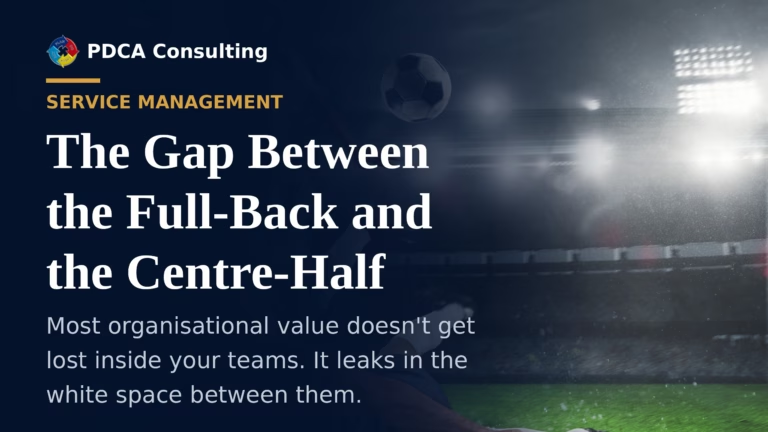
Most organisational value doesn’t get lost inside your teams. It leaks in the white space between them.
If you run IT for a firm of 500 to 2,000 people, and your service desk closes its tickets on time while your users still complain, this one is for you.
Your teams hit their targets. Your dashboards are mostly green. Your customers still complain about things nobody on any of those dashboards owns. The same ticket bounces between two queues for a week, and both teams can prove it wasn’t theirs. And when you ask who’s accountable for the handoff, the room goes very quiet.
That unowned ground has a name. Geary Rummler and Alan Brache called it the white space: the gaps between functions where work changes hands, and where most of the value quietly drains away. I’ve spent a fair chunk of my career being called in after the leak was spotted, usually by the customer first, and the pattern rarely changes. The teams are fine. The white space is not.
If you’ve watched Liverpool for any length of time, you’ve seen the goal. The right-back tracks his winger inside. The centre-half holds his line for an offside trap that never quite arrives. The striker strolls through a channel exactly wide enough for one man and a football. Neither defender did anything wrong by the letter of his job. The full-back marked his man. The centre-half held his zone. The goal went in on six yards of turf that belonged to neither of them.
Your organisation has that gap too. It just wears a lanyard instead of shin pads.
In this blog, we’ll explore:
- Why the white space, not the teams, is where value leaks
- How the ball gets through even when you’ve got good players on the pitch
- What the white space looks like on a typical service desk
- Two moves, in a strict order, that keep it marked
Nobody’s Ball, Nobody’s Fault
Rummler and Brache spent a career making the same point about businesses that pundits make about back fours: the org chart is not the game. It shows who reports to whom, which is useful for payroll and useless for understanding how work gets done. Turn the chart on its side and you get the picture that actually matters: the customer, the product, and the flow of work passing between functions like a ball moving between markers.
The white space is where marketing hands a brief to product, where sales hands a signed contract to delivery, where one team’s output becomes another’s input. Their finding, after decades of consulting, was blunt: the biggest performance losses in most organisations happen not inside any function, but in the unmarked ground between them. Everyone’s doing their job. The ball still gets through.
Which handoff in your organisation would nobody put their name to?
Three Ways the Ball Gets Through
No one’s marking the run. Interfaces only get managed if someone is explicitly accountable for them, and in most structures nobody is. The full-back’s job is the full-back. The centre-half’s job is the centre-half. The white space between them belongs to whoever happens to notice in time, which in practice means nobody.
Reorganising just moves the six-yard box. Restructure around process instead of function and the white space doesn’t vanish; it reappears between the new boxes. The aim was never to eliminate the gap. It’s to keep it marked.
Local heroics, global own goal. A function hits every KPI on its dashboard while quietly making life harder for whoever’s next in the chain. Manufacturing meets its yield targets; distribution inherits an inventory problem nobody budgeted for. Everyone wins their individual duel. The team still concedes, and because every dashboard is green, nobody looks in the white space for the reason.
Value Isn’t Scored, It’s Assisted
Value isn’t something one function manufactures and lobs over the fence to the next. It’s built in the exchange between whoever provides and whoever consumes, at every handoff, all the way down the chain. Marketing consumes R&D’s output and provides for sales. Sales consumes product specs and provides for delivery. The customer only receives value at the end if every one of those internal exchanges holds up.
So the white space isn’t administrative debris to be tidied up later. It’s where value is either created or quietly isn’t. Think of it as the assist rather than the goal: nobody puts it on the highlights reel, but without it nothing goes in.
What the White Space Looks Like on Your Service Desk
You can watch this happen inside a single IT department on a wet Tuesday afternoon.
Take the seam between the service desk resolving incidents and the change team that authorises fixes. The desk’s job is to restore service fast. Change’s job is to protect the estate from reckless edits. Both are doing exactly what they’re measured on. The value leaks in between: the urgent workaround that quietly becomes permanent because nobody owned the handoff back to change, and six months later it’s the undocumented thing that takes down a release. Neither team failed. The pass between them was never marked.
It isn’t the only seam. On most service desks the white space turns up in the same four places:
- Escalation from first line to second line, where a ticket arrives with “user says it’s broken” and nothing else, so the specialist starts again from zero.
- The step from fixing the fault to finding its cause, where the same printer gets fixed fourteen times because nobody’s job is to ask why it keeps coming back.
- Supplier boundaries, where your desk can watch a ticket ageing in someone else’s queue but can’t touch it.
- The route back to the user, where a ticket is closed as resolved and the person who raised it is the last to find out.
Each one has the same signature: two teams with clear jobs, and a gap with no owner. Your customers don’t experience your org chart. They experience the white space in it.
If you followed one ticket from first call to closure this week, how many times would it change hands without anyone owning the pass?
Two Moves That Mark the White Space
Spot a leaky handoff and the instinct is to buy a tool. That’s the wrong first move. Two moves work, and the order matters more than either of them.
First, simplify the handoff. Every unnecessary approval or extra handover is another patch of unmarked turf. Each extra step costs time; worse, it widens the white space an attacker can run into. A single approval gate that everyone understands defends the channel better than four that each assume one of the others is watching it. Strip out the steps nobody can justify, name one owner for the pass, and agree what “done” looks like before the ball moves.
Then, and only then, automate it. Automating a messy interface just means it fails faster and with better paperwork. Applied to a handoff you actually understand, automation is how an ungoverned seam becomes a managed, predictable one. It’s the difference between a defender reacting to the run and a defence that’s drilled the shape so the run never opens up.
Get those two right, in that order, and everything else you want to improve has something solid to build on. Skip the order and you’ve just automated chaos, which is worse than chaos, because now it’s fast.
Which of your handoffs got automated before anyone simplified it?
The Final Whistle
Nobody loses a business the way Liverpool occasionally lose a goal: spectacularly, in front of sixty thousand people, replayed from four angles. It leaks out quietly instead, six yards at a time, through gaps that both sides swear were the other one’s zone. The fix isn’t better full-backs or better centre-halves. It’s someone whose actual job is marking the white space between them.
Take just one of those seams. If your desk escalates 400 tickets a month and each arrives as “user says it’s broken”, costing the specialist 20 minutes to start again from zero, that’s over 130 hours a month: nearly a full-time person, paid to repeat work that already happened once.
If that sounds like your service desk, a Service Desk Assessment & Improvement is the quickest way to find which handoffs are leaking and who should own them. For the framework-minded, simplify first and automate second comes straight from the guiding principles taught in PeopleCert’s ITIL Certifications.
To find out more about PDCA Consulting’s expert consulting services either:
- Book 30-minute conversation directly: here
- Get in touch via the contact form here
- Connect with me on LinkedIn
Robert Pinnington
Turning struggling Service Desks & PMOs into high-performing ones