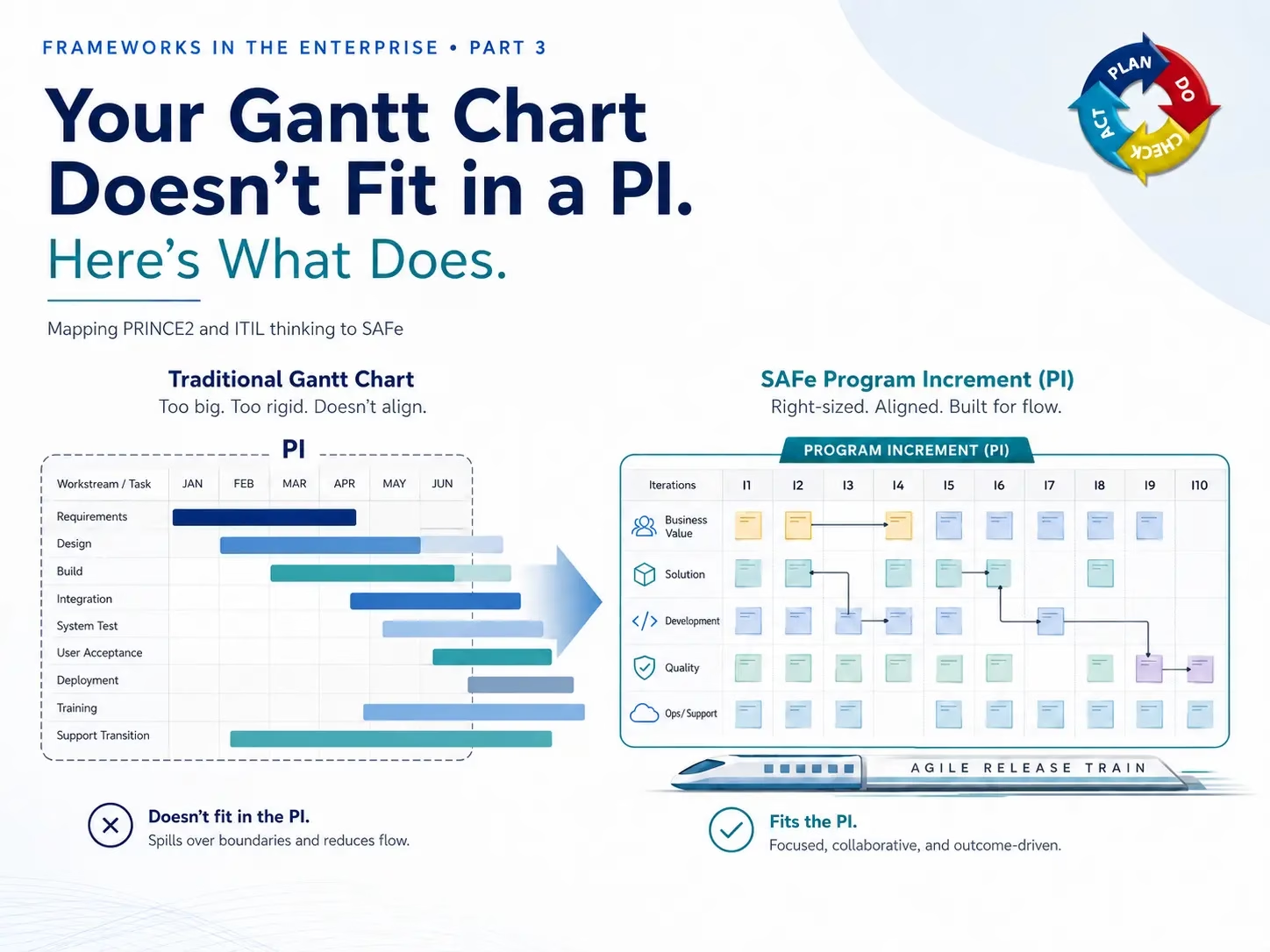
You know PRINCE2. You know ITIL. You’ve spent years building governance structures that work, managing projects through controlled stages, running service desks that actually function. And now someone has introduced SAFe into your organisation and you’re sitting in a PI Planning session wondering what on earth an ART Sync is and why the RTE keeps talking about WSJF.
This blog is your translation guide. It maps the constructs you know from PRINCE2 7 and ITIL (Version 5) to their SAFe equivalents, not to suggest they’re identical (they’re not), but to give you enough fluency to operate effectively in a hybrid environment and to spot the governance gaps that SAFe alone doesn’t fill.
Understanding What SAFe Actually Is
SAFe (Scaled Agile Framework) is a framework for delivering software and digital products at scale. It organises work around Agile Release Trains (ARTs), teams of Agile teams, typically 50–125 people, that plan, commit and deliver together on a shared cadence called a Programme Increment (PI), which runs every 8-12 weeks.
The critical thing to understand from a PRINCE2 perspective is that SAFe governs delivery, not investment. It tells you how work gets organised and executed. It does not provide business justification, stage-gate governance, or benefits realisation structures. PRINCE2 fills those gaps. SAFe knows this, it’s not an oversight, it’s a deliberate boundary.
Similarly, SAFe governs delivery up to the point of production release. What happens after that, service operations, incident management, change enablement, continual improvement, is ITIL’s domain.
Section 1: PRINCE2 7 Principles Mapped to SAFe
| PRINCE2 7 Principle | Description | SAFe Equivalent / Expression |
| Continued Business Justification | Project must remain viable throughout its lifecycle | Portfolio Epic hypothesis and ongoing LPM review; Business Owner accountability |
| Learn from Experience | Lessons captured and applied throughout | Inspect & Adapt workshops; Iteration Retrospectives; Innovation & Planning iterations |
| Defined Roles and Responsibilities | Clear accountability at all levels | Explicit SAFe role definitions: RTE, STE, PO, PM, System Architect, Business Owner |
| Manage by Stages | Divide work into manageable, reviewable chunks | Project stages delivered via the ART; PI boundaries act as the project’s stage-gate checkpoints, while the PI itself is the programme increment, governed at MSP level |
| Manage by Exception | Escalate only when tolerances are breached | ART-level impediment escalation; RTE escalates to LPM when PI objectives at risk |
| Focus on Products | Define and deliver agreed outputs | Features, Capabilities, and Epics with clear Acceptance Criteria; Definition of Done |
| Tailor to Suit the Project | Apply proportionately to context | SAFe configurations: Essential, Large Solution, Full SAFe, scale to need |
Section 2: PRINCE2 7 Practices Mapped to SAFe
PRINCE2 7 replaced Themes with Practices in the current edition. Each Practice maps meaningfully to SAFe constructs, though the implementation differs significantly.
| PRINCE2 7 Practice | PRINCE2 Focus | SAFe Equivalent | Key Difference |
| Business Case | Justify and track investment value | Portfolio Epic with hypothesis and Lean Business Case | SAFe Business Case is lighter; formal investment approval sits outside SAFe |
| Organisation | Define roles and accountability structure | SAFe Role Framework: ART, STE, LPM | SAFe is flatter; no formal Project Board equivalent within the ART |
| Plans | Create and maintain realistic plans | PI Roadmap, ART Roadmap, Solution Roadmap, Iteration Plans | SAFe plans are rolling and adaptive; PRINCE2 plans more baseline-controlled |
| Risk | Identify, assess and control risks | ROAM Board (Resolved, Owned, Accepted, Mitigated) | ROAM is faster and more visual; PRINCE2 Risk Register is more formally maintained |
| Quality | Define, verify and approve outputs | Definition of Done, Acceptance Criteria, System Demo, Inspect & Adapt | Quality in SAFe is embedded in cadence rather than formal quality reviews |
| Change | Control scope changes formally | Backlog management; Feature/Story refinement; uncommitted objectives | SAFe embraces change within PI; PRINCE2 has formal change control procedures |
| Progress | Monitor and report against baseline | PI Metrics, Predictability Measure, ART Sync, Program Board | SAFe uses visual radiators and cadenced events rather than formal progress reports |
Section 3: PRINCE2 7 Processes Mapped to the SAFe ART Lifecycle
| PRINCE2 7 Process | When It Occurs | SAFe Lifecycle Equivalent |
| Starting Up a Project | Pre-project; mandate received | Pre-PI preparation; Value Stream identification; initial ART formation |
| Initiating a Project | Start of project; PID created | ART Launch; PI 1 Planning; initial Program Backlog creation |
| Directing a Project | Throughout; Project Board oversight | LPM governance; Portfolio Kanban Epic approval; Business Owner engagement |
| Controlling a Stage | During each stage; PM day-to-day | PI execution; Iteration planning, review and retrospective; ART Sync |
| Managing Product Delivery | Teams delivering work packages | Team-level Scrum/Kanban; Feature and Story development and acceptance |
| Managing a Stage Boundary | End of each stage; replanning | PI boundary; System Demo; Inspect & Adapt; next PI planning preparation |
| Closing a Project | End of project; handover | Solution completion; benefits handover; ITIL service transition initiation |
| The PI boundary works at two altitudes: a stage-gate checkpoint for the PRINCE2 project the ART delivers, and a tranche checkpoint for the MSP programme the increments serve, both moments to review delivery, revalidate the plan, and make a conscious decision to continue or change course. |
Section 4: ITIL (Version 5) Service Value Chain Mapped to SAFe
ITIL (Version 5)’s Service Value Chain describes six activities that together create value from demand to realisation. Three of these are directly relevant to how SAFe delivery feeds into live service operations.
| ITIL (Version 5) Value Chain Activity | ITIL Focus | SAFe Connection | Practical Integration Point |
| Plan | Strategic and tactical planning for services | LPM Portfolio planning; Roadmap alignment | Portfolio-level alignment between LPM and ITIL Service Strategy |
| Engage | Understanding stakeholder demand and needs | Product Manager customer engagement; SAFe Communities of Practice | Voice of Customer feeding Product Backlog; service demand shaping Features |
| Design & Transition | New/changed services ready for operations | PI System Demo; Release on Demand; DevOps pipeline | Critical handover point, ART release to ITIL service operations |
| Obtain/Build | Procurement and development of service components | ART delivery of Features and Capabilities | ART is the primary build engine; ITIL governs what gets built into a service |
| Deliver & Support | Live service operations and incident handling | Post-release operations; Defect management | Where ART output becomes an ITIL service; SLA/OLA accountability begins |
| Improve | Continual service and practice improvement | Inspect & Adapt; Iteration Retrospectives; Innovation Sprints | SAFe Continuous Learning Culture aligns directly to ITIL Continual Improvement |
Section 5: Key SAFe Ceremonies: A PRINCE2/ITIL Translation
For the PRINCE2 or ITIL practitioner attending SAFe ceremonies for the first time, here is what each one is and what its governance equivalent looks like.
| SAFe Ceremony | Frequency | Purpose | PRINCE2/ITIL Equivalent |
| PI Planning | Every 8-12 weeks | All ART teams plan the next Programme Increment together | Stage boundary planning + initiation combined |
| Iteration Planning | Every 2 weeks | Team plans the next sprint/iteration | Work Package agreement at team level |
| ART Sync | Weekly | RTE-led cross-team coordination; impediment removal | Highlight Report equivalent; exception management forum |
| System Demo | End of each iteration/PI | Integrated solution demonstrated to stakeholders | End Stage Review / Quality Review |
| Inspect & Adapt | End of PI | PI metrics reviewed; improvement actions agreed | End Stage Report + Lessons Learned + replanning |
| Innovation & Planning (IP) Iteration | End of PI cadence | Buffer for innovation, training, PI planning prep | No direct equivalent; closest to planning tolerance |
| ROAM Session | During PI Planning | Risks identified and categorised | Risk Workshop; Risk Register update |
| Backlog Refinement | Ongoing | Features/Stories prepared and estimated | Product Description development; Work Package scoping |
Section 6: Role Mapping Across All Three Frameworks
| SAFe Role | PRINCE2 7 Equivalent | ITIL (Version 5) Equivalent | Notes |
| Business Owner | Executive / Sponsor | Service Owner (business) | Highest business accountability; benefits realisation owner |
| Product Manager | Senior User / Business Change Manager | Service Owner (operational) | Manages the what; owns the vision and roadmap |
| Release Train Engineer | PRINCE2 Senior Supplier (delivery facilitation); MSP programme-office delivery coordination | Change Enablement Lead | Servant leader; facilitates; does not command |
| Solution Train Engineer | MSP Programme Manager / SRO support (multi-ART) | Service Design Authority | Coordinates multiple ARTs; manages solution-level complexity |
| Product Owner | Team Manager / Work Package owner | Service Request management | Manages team backlog; accepts stories; owns iteration content |
| System Architect | Senior Supplier (technical) | Technical Management Practice lead | Defines technical guardrails; enables cross-team alignment |
| LPM Function | Programme Board / Corporate Governance | Service Strategy / Portfolio Management | Investment decisions; strategic theme alignment; Epic approval |
| Agile Coach | No direct equivalent | Continual Improvement Practice | Coaches SAFe practices; closest to PRINCE2 Assurance function |
Section 7: The Integration Model: Putting It Together
Having mapped the components, the practical integration model looks like this. Think of it as three concentric rings of governance.
Outer Ring: Programme & Portfolio Governance (MSP + PRINCE2 + LPM)
Strategic investment decisions, programme-level Business Cases, and benefits realisation are governed by MSP at programme level, its Justification theme and benefits management sitting above the individual PRINCE2 project Business Cases, working alongside SAFe’s Lean Portfolio Management function. The Project Board equivalent is the LPM team, supported by MSP’s programme governance and PRINCE2’s formal project structures for investment approval and stage-gate decisions.
Middle Ring: Delivery Governance (SAFe)
The ART and Solution Train operate here. PI Planning, ART Syncs, System Demos, and Inspect & Adapt are the primary governance mechanisms. PRINCE2 contributions at this level are lighter, providing Business Case oversight, exception escalation routes, and Quality expectations, but the delivery cadence is owned by SAFe.
Inner Ring: Service Operations (ITIL)
Once a PI release reaches production, ITIL takes over. Design & Transition ensures operational readiness. Deliver & Support maintains service reliability. Change Enablement controls further changes to live services. The Continual Improvement practice picks up where SAFe’s Inspect & Adapt leaves off in the production environment.
| MSP justifies the journey and owns the destination. PRINCE2 plots each leg and keeps it on course. SAFe drives the vehicle. ITIL services the road. All four are necessary for enterprise digital delivery at scale. |
Practical Guidance for PRINCE2/ITIL Practitioners in a SAFe Environment
- Attend at least one full PI Planning session before forming any opinion about SAFe. It is genuinely different from anything in PRINCE2 or ITIL and needs to be experienced to be understood.
- Bring your PRINCE2 Business Case thinking into the LPM function. The Lean Business Case SAFe uses is deliberately lightweight, your governance experience will strengthen it without bureaucratising it.
- Treat the PI boundary as your Stage Gate. Bring your End Stage Report thinking to the Inspect & Adapt workshop. The information is the same; the format is different.
- Champion the Design & Transition connection. In most SAFe implementations, the handover to operations is the weakest point. Your ITIL expertise is most valuable precisely here.
- Don’t try to impose PRINCE2 process on team-level delivery. The Iteration is not a mini-project. The Product Owner is not a Work Package owner in the PRINCE2 sense. Let SAFe govern what SAFe governs.
- Build a shared language document for your organisation. The mapping tables in this blog are a starting point, but your organisation’s specific integration points need to be agreed, documented and communicated to all three communities of practice.
To find out more about PDCA Consulting’s expert consulting services or coaching either:
- Call +49 172 579 4719
- Complete the contact form
- Contact via LinkedIn
Read the full Frameworks in the Enterprise series:
- Part 1: Do You Need SAFe, PRINCE2 and ITIL, or Are You Just Collecting Frameworks? (for senior leaders)
- Part 2: You’ve Got an ART. Now Who’s Governing the Business Case? (for SAFe practitioners)
- Part 3: Your Gantt Chart Doesn’t Fit in a PI. Here’s What Does (for PRINCE2 and ITIL practitioners)
- Bonus: Programme Governance with MSP, PRINCE2, SAFe and ITIL (for programme leaders)
This series maps how PRINCE2 7, SAFe, MSP and ITIL (Version 5) fit together in real enterprise governance.
About the author: This series is produced by a PRINCE2 7 Master and ITIL Master (Version 5) practitioner working in the DACH region, specialising in governance, programme and service management, and agile transformation.