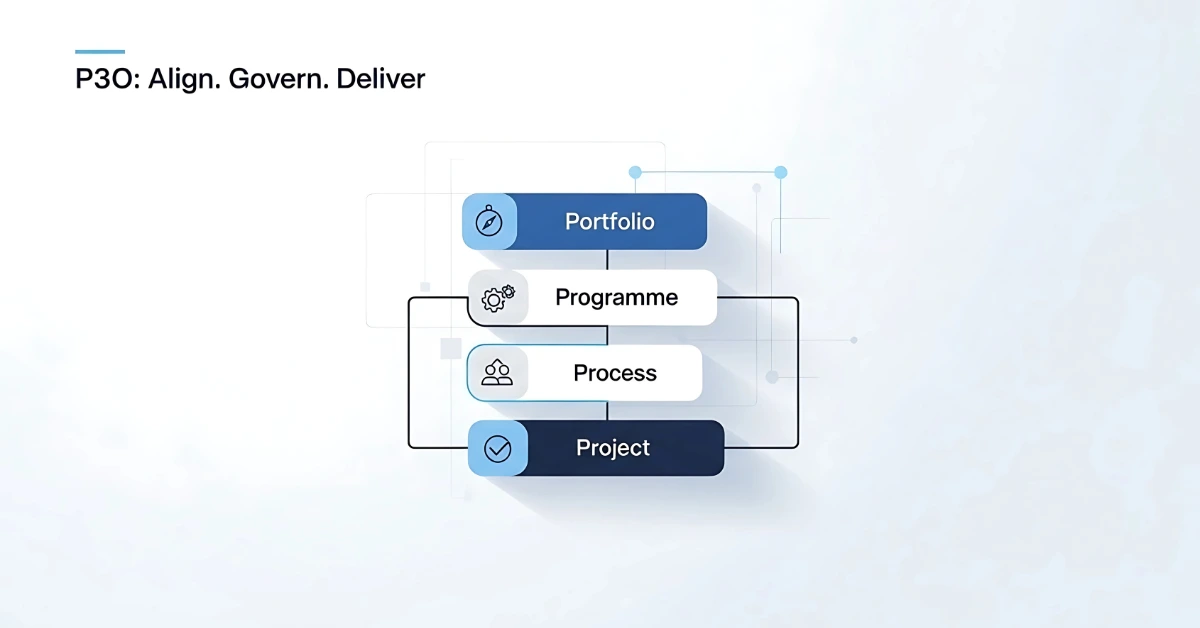
Portfolio, Programme and Project Offices (P3O) is a guidance developed by Axelos and PeopleCert that provides a set of principles, processes and techniques to help organizations deliver their strategic objectives through effective portfolio, programme and project management. P3O enables organizations to establish, develop and maintain appropriate governance structures that facilitate decision making, prioritization, resource allocation, risk management and performance measurement. P3O also supports the delivery of change initiatives by providing consistent standards, methods, tools and assurance across the portfolio, programme and project life cycles.
Benefits of P3O
P3O can help organizations optimize their portfolios, programmes and projects in various ways, such as:
- Aligning the portfolio, programme and project objectives with the organizational strategy and vision, ensuring that the right initiatives are selected and executed to deliver the desired outcomes and benefits.
- Enhancing the efficiency and effectiveness of portfolio, programme and project management by applying best practices, reducing duplication, resolving conflicts and improving communication and collaboration among stakeholders.
- Increasing the transparency and accountability of portfolio, programme and project performance by establishing clear roles and responsibilities, reporting mechanisms, escalation procedures and audit trails.
- Improving the quality and reliability of portfolio, programme and project outputs and outcomes by implementing robust quality assurance, risk management, change control and assurance processes.
- Enabling continuous improvement and learning by capturing and sharing lessons learned, feedback, knowledge and experience across the portfolio, programme and project levels.
P3O Certification
PDC Consulting offer two levels of P3O certification for individuals who want to demonstrate their knowledge and skills in applying the P3O methodology:
- P3O Foundation: This level covers the basic concepts, terminology and principles of P3O, as well as the roles and functions of a P3O model. It is suitable for those who are new to P3O or who work in a P3O environment and need to understand how it operates.
- P3O Practitioner: This level covers the practical application of P3O, including how to design, implement, manage and improve a P3O model. It is suitable for those who are responsible for or involved in setting up, running or working within a P3O.
Conclusion
P3O is a valuable methodology that can help organizations optimize their portfolios, programmes and projects by providing a framework for governance, management and delivery of change initiatives. P3O can help organizations achieve their strategic goals, improve their performance, increase their value and enhance their maturity. P3O certification can help individuals gain recognition and credibility for their P3O expertise and competence.
To find out more about our expert consulting services either:
- Complete the contact form
- Contact via Linkedin https://www.linkedin.com/company/pdca-consulting
- Call +49 172 579 4719
- Scan the QR Code for later