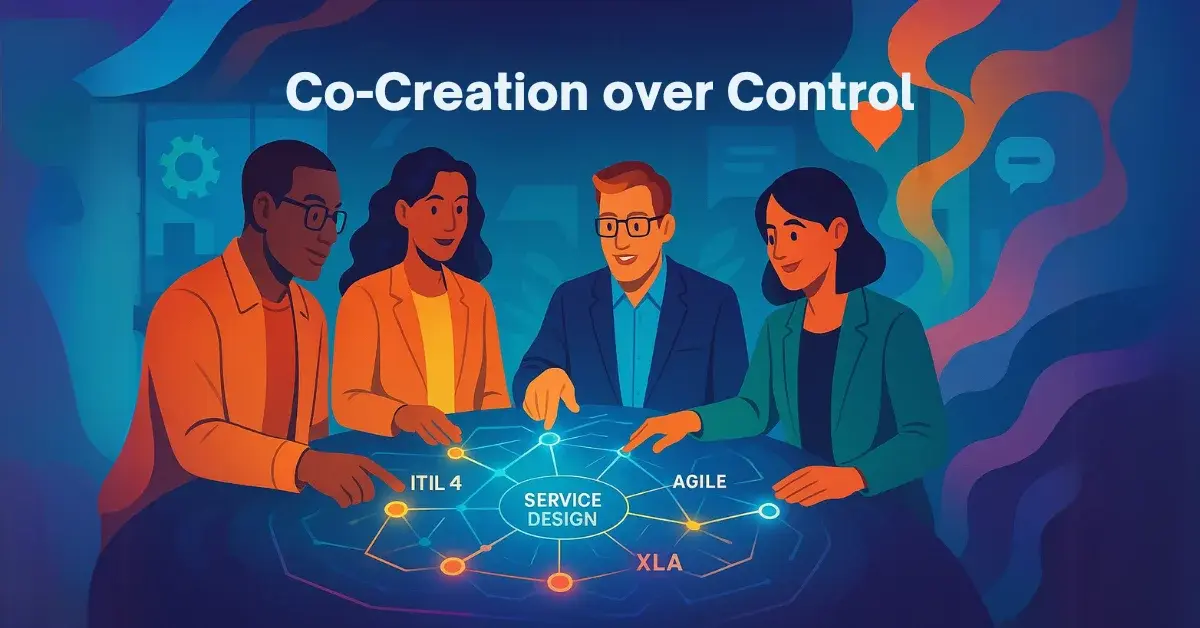
Service management has always aimed to deliver value. But in a world moving toward Industry 5.0, that value can no longer be created without co-creation or in isolation. Customers aren’t just passive recipients—they’re collaborators. Employees aren’t just executors—they’re contributors to service evolution.
The future belongs to organisations that can co-create services alongside their stakeholders. In this blog, we’ll explore:
- What co-creation means in the context of Industry 5.0
- How ITIL 4 supports the transition to Collaborative Service Management.
- Why old control-centric models are fading fast
- How PDCA Consulting brings co-creation to life through practical frameworks and facilitation
The End of the Control Era in Service Management
Traditional service management was based on predictability, standardisation, and command-and-control governance. This worked well in stable, tech-driven environments—but it falls short in today’s complex, rapidly evolving ecosystems. Services are now fluid, driven by changing expectations, and shaped by real-time user input.
Trying to control every variable is no longer viable—and often counterproductive. Co-creation emerges not as a fad, but as a necessity.
What Co-Creation Really Means
Co-creation isn’t just involving the customer in a feedback form. It’s an active, ongoing collaboration between service providers, users, and stakeholders to design, deliver, and improve services together. It implies:
- Joint ownership of outcomes
- Transparent communication
- Willingness to adapt based on feedback
When co-creation is done right, services become more relevant, inclusive, and resilient.
ITIL 4 and the Foundation of Co-Creation
ITIL 4 positions co-creation at the centre of its Service Value System. Its guiding principles such as:
- ‘Collaborate and promote visibility’
- ‘Think and work holistically’
- ‘Focus on value’
These help organisations break down silos, build trust across teams, and integrate stakeholder views from strategy to execution. ITIL 4 encourages the design of services *with* people, not *for* people.
Why Co-Creation Beats Control in Industry 5.0
Industry 5.0 demands services that reflect ethics, inclusion, and well-being. These values cannot be embedded in a vacuum. They must be shaped by diverse inputs. Co-creation helps:
- Bridge user-expectation gaps
- Adapt services to cultural and contextual nuances
- Avoid costly assumptions and rigid service failures
The best services evolve dynamically—with stakeholders influencing roadmaps, priorities, and metrics.
How PDCA Consulting Brings Co-Creation to Life
We go beyond theory to make co-creation operational:
- Facilitate stakeholder alignment workshops across departments
- Train service managers in ITIL 4 co-creation principles
- Build service design blueprints incorporating XLA-based feedback loops
- Lead cross-functional simulations to develop collaborative habits
Our consultants tailor approaches to your culture and maturity level—ensuring co-creation becomes a strategic capability, not just a one-time workshop.
Final Thoughts: Building Shared Value, Together
When you let go of control, you don’t lose power—you gain perspective. Co-creation is how organisations build trust-based services, relevance, and resilience. In the shared value era, service excellence comes from listening, adapting, and designing *with* those who matter most.
With ITIL 4 and PDCA’s facilitation, co-creation becomes your greatest differentiator.
To find out more about PDCA Consulting’s expert consulting services either:
- Complete the contact form
- Contact via Linkedin
- Call +49 172 579 4719
How PDCA Consulting Helps with the Transformation
PDCA Consulting empowers organisations to navigate Industry 5.0 by delivering:
- Coaching and training in ITIL 4 and PRINCE2 7
- Experience Co-Creation metrics (XLAs) and service co-creation frameworks.
- Agile Governance aligned with transparency and trust.
- Human-Centric Service Design and cultural transformation.
- Leadership development for empathy, ethics, and systemic change
From blueprinting to behavioral change, PDCA enables human-centric innovation—practically and sustainably.